A Dog's Soul Reincarnates as a Human
The Art of Racing in the RainA Dog's Soul Reincarnates as a Human is the spiritual belief that gives Enzo a way to imagine death as passage rather than erasure. Recalling a television documentary about dogs in Mongolia, he understands that a dog’s soul is released after death to run through the world until it is ready to be reborn as a human being. The idea becomes more than an account of what may happen after life: it offers Enzo a future in which he can return to the people he loves, even as he must face leaving them in the present.
The Belief and Its Source
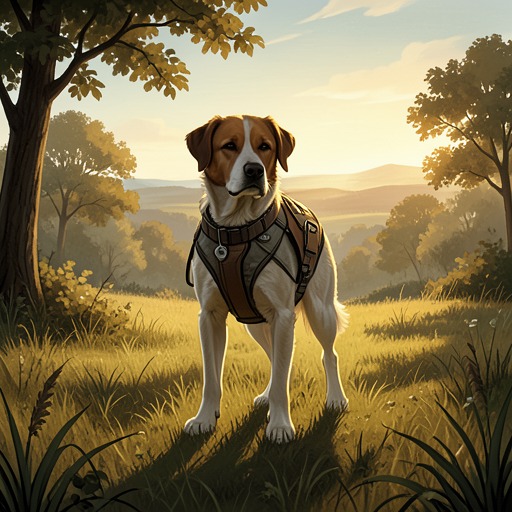
Enzo’s account begins with a documentary he watched on television. It presents two connected claims: a dog ready to leave its dog nature behind may be reborn as a man, and, after death, a dog’s soul is released to roam until it is ready for rebirth. Enzo recalls the second teaching at the end of his life, when the possibility is no longer abstract. The soul’s freedom is pictured as movement through an open natural world, with fields, wind, rivers, rain, and sunlight; the interval before rebirth is not described as a fixed destination or a known length of time, but as a period of running until readiness.
The novel presents these claims through Enzo’s own understanding, not as an independently verified account of animal afterlife. Their force comes from how he uses them: they give an animal narrator a spiritual history and a future beyond the limits of his present body. His confidence in this possibility is intimate and personal, founded on a documentary he remembers and on his expectation that he will be able to recognize and seek out the people who matter to him.
A Dog’s Perception and Human Limits
The possibility of crossing from dog to human belongs to a larger tension in Enzo’s experience. He describes himself as capable of understanding human feeling through bodily cues that people may not notice. He detects Eve’s illness by its odor before it is identified by medical examinations, and he senses her anxiety through the physical changes he associates with fear. Yet perception does not give him the ability to explain what he knows. He cannot warn Eve in words or make his understanding available to the family in the way a human speaker could.
That boundary is also emotional. Enzo knows Eve has entrusted him with protecting Zoë, but cannot protect Eve from her illness. After Eve dies, his grief is expressed through a return to animal action: at Luther Burbank Park he runs away from Denny, hunts a squirrel, and later dreams of chasing crows. The narration connects this loss of restraint to his wish to escape the pain he experiences as a humanlike mind inside a dog’s life. The episode does not establish reincarnation as the cause of his behavior. Instead, it places his spiritual hope alongside the limits of his present form: Enzo can interpret, remember, and love, but he cannot speak or act as a human would.
The same difference appears in the family’s ordinary life. Zoë once called the floating bridge the High 90, and Enzo remembers that small detail as part of their shared history. His bond with the family is made of such close observation and companionship, but the full meaning of those bonds cannot be communicated by speech. The promised human life offers an imagined reversal: the dog who has understood people without being able to answer them hopes to return able to approach and speak.
Rebirth, Memory, and the New Champion
The belief also informs Enzo’s reflections on Luigi Chinetti. After recounting Chinetti’s endurance as a driver and his achievements in racing and business, Enzo wonders who now possesses Chinetti’s soul. He imagines that a child might carry forward, without knowing its spiritual origin, qualities such as endurance, quick intelligence, dexterous hands, and a natural aptitude for racing. The thought leads to the suggestion that a new champion is already among the living. The identity of that child is not given, and the passage leaves the possibility in the form of spiritual speculation rather than a confirmed reincarnation.
This reflection makes rebirth a way of thinking about continuities that may exceed conscious memory. A person might display an affinity or ability without knowing where it came from; the past, in Enzo’s interpretation, can persist as disposition rather than recollection. Chinetti’s story therefore broadens the belief beyond Enzo’s wish to return to his own family. Reincarnation may also explain, for Enzo, how a life devoted to racing could leave traces in another life, although the text does not identify any person as Chinetti’s successor.
The idea of a soul departing when its work is finished gives the belief a related but distinct emphasis. Enzo considers the possibility that a life ends when its body has served its purpose and its soul has learned what it came to learn. He contrasts that thought with his own survival: he understands that he was not finished and still had work to do. In this framing, death and continuation depend not simply on the body’s condition but on a soul’s unfinished purpose. The belief thus accommodates both departure and return without claiming that every transition can be known in advance.
Enzo’s Farewell and Intended Return
As Enzo approaches death, the remembered teaching becomes a promise he makes to himself. He believes he will be reborn as a man and will find Denny and Zoë. He imagines walking up to them, shaking their hands, and telling them that Enzo says hello. The gesture matters: a handshake is a distinctly human form of greeting, and in his imagined future it will let him make himself known where his present life permits only other kinds of communication.
That anticipated reunion does not make leaving easy. Enzo recognizes that Denny is deeply sad and would rather remain with him and Zoë in the apartment, watching people below in the street. Denny tells him that Enzo has always been his, affirming a bond that does not depend on the prospect of rebirth. Enzo accepts the truth of that relationship even as he holds to the hope of finding them again. The belief offers continuity, but it does not erase the immediate cost of separation.
When Denny tells him he can go, Enzo’s attention turns to the fields around Spangle. He imagines a landscape without fences, buildings, or people, where he can run freely through grass beneath sky. The image brings the documentary’s teaching to its final form: after death, the soul is released to run until it is ready to be reborn. Enzo’s farewell therefore holds two wishes at once—to stay with Denny and Zoë, and to trust that departure will eventually lead him back to them. Reincarnation is the narrative’s assurance of possible reunion, while the open fields preserve the uncertainty and freedom of the journey in between.